


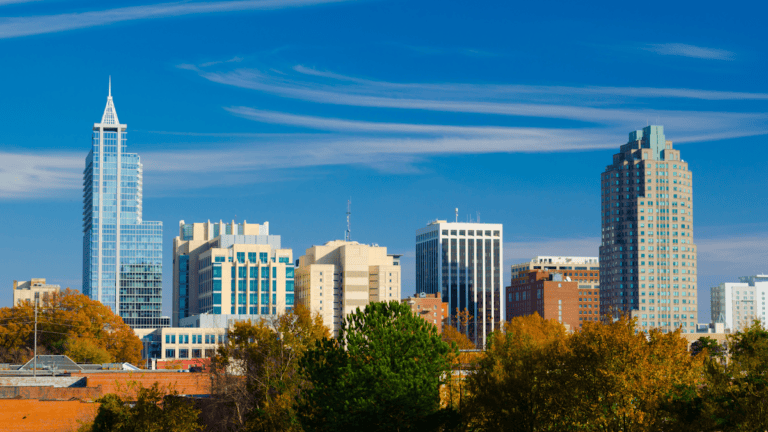
After the Raleigh City Council rejected its initial rezoning request in 2023, a real estate development company faced an uphill battle to advance its proposed development in downtown Raleigh.
Organized opposition had shaped negative public sentiment, leaving the developer to face skeptical city council members, contentious public meetings, and unfavorable messaging and visuals.
The main concern was that the proposed buildings would be too tall and too close to a historic neighborhood. There were also concerns about whether the city followed the proper rezoning process; how construction could affect the area through noise, traffic, and pollution; and the potential impact on the neighborhood’s character.
Without a reset in both narrative and engagement strategy, the project risked becoming another stalled downtown proposal.
The developer engaged E&V’s Public Engagement team to provide strategic communications counsel and hands-on support to help overcome resistance, elevate credible third-party voices, and rebuild momentum ahead of a renewed city council vote.
E&V developed a comprehensive public engagement and communications strategy to support the developer’s lobbying efforts with the city council while reshaping how the project was understood by decision-makers, stakeholders, and residents.
While the opposition was vocal and well-organized, some of its arguments exaggerated the project’s potential impacts or overlooked its alignment with the city’s existing plans.
Rather than engage in a back-and-forth with opponents, the developer focused on demonstrating how the project supported the city’s long-term vision and would benefit the broader community. Credible, independent voices helped reinforce the developer’s position, both publicly and through direct conversations with key decision-makers.At the core of the strategy was a disciplined messaging framework that clearly articulated the project’s benefits while directly addressing concerns raised by opponents. Rather than relying solely on the developer’s voice, E&V prioritized amplifying trusted third-party advocates who could speak authentically and credibly about the project’s value.
Close coordination with the developer and its legal team allowed E&V to adjust tactics as city council sentiment, opposition narratives, and news cycles evolved.
E&V led the development of a key messaging library to guide outreach to city council members, planning staff, and other decision-makers, ensuring message consistency across private meetings, public testimony, and digital channels. To broaden support beyond the developer’s voice, E&V worked with the developer to identify and mobilize local leaders, business owners, and residents who could share their perspectives through op-eds, public meetings, and targeted social media outreach.
Recognizing the power of visuals in shaping perception, E&V also recommended new renderings and creative assets that more accurately reflected the project’s potential and addressed misconceptions fueled by opposition imagery. These materials supported media outreach and in-person engagements to reinforce a clearer vision for the site.
In fall 2025, the Raleigh City Council approved the developer’s rezoning request. Both the mayor and multiple council members publicly cited the developer’s strong and thoughtful public engagement efforts as a key factor in their support.
“I want to acknowledge the development team for responding to feedback,” a city council member said. “I also want to recognize the level of community engagement on this case. It has been extraordinary.
“We received more input than before from supporters and opponents alike,” continued the council member. “I am so grateful for that effort. Conversation doesn’t always lead to agreement, but it should lead to understanding.”
The approval marked a decisive turnaround from the project’s earlier rejection and demonstrated the impact of a disciplined, adaptive public engagement strategy – onethat not only countered organized opposition, but rebuilt trust and credibility with elected officials at a critical moment in the process.
The downtown development demonstrated that an earlier rejection does not have to define a project’s future. Strategic public engagement can build credibility, broaden support, and create a path toward approval.


